
 |
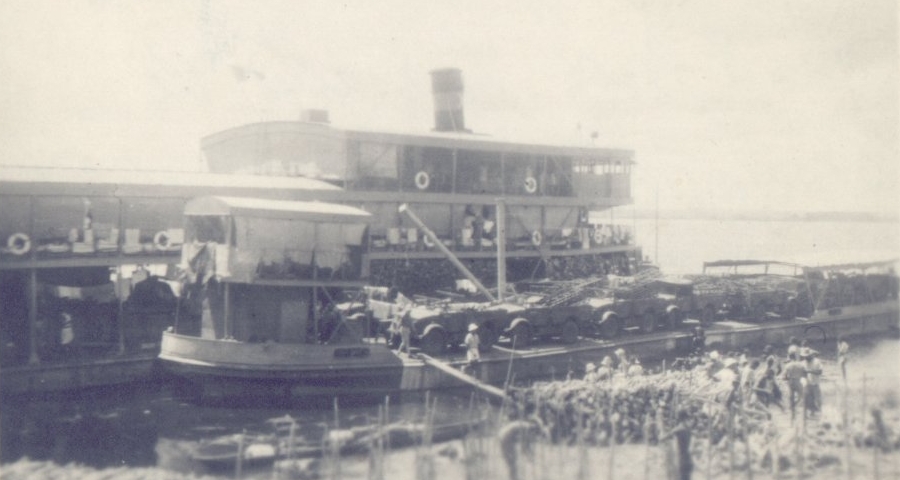
| The Paddle Steamer "La Fondère" on the Congo, 1941. The long barge in the foreground is the "William Guynet". |
 |
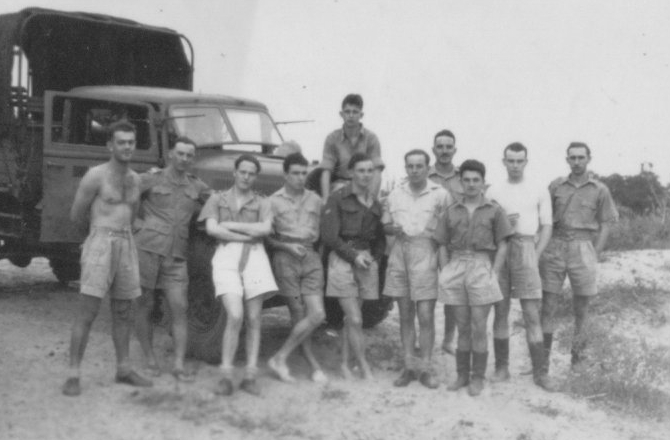
| Left to right, crouching; Rio, Eve, Creusat, Baudon, Leleu, Lt Imbert. Standing; Maurinkovic, Alençon and Tracqui at Fort Archambault, 1941. |
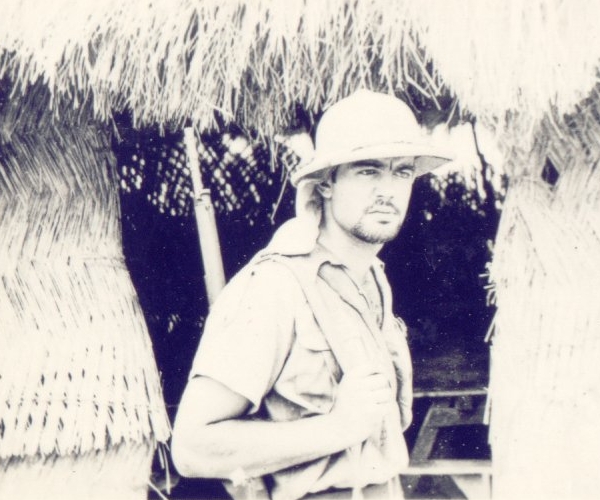 |
| François René Tracqui at Fort Archambault, 1941. |
 |
| Tracqui, Imbert, Pouille, Kermel, Menguy, Guenan, Huguet, Michard, Thuayre, Perrot, Eve, 1942. |
 |
| René Rayez on the left with Aymar de Villeglé relax. |
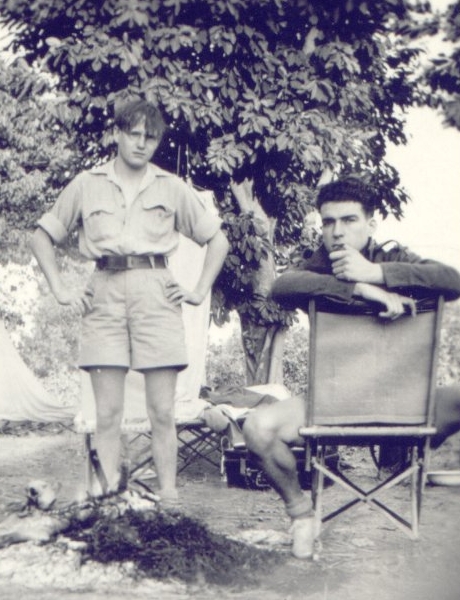 |
| Raymond Pouille on the left with Jean Kermel. |
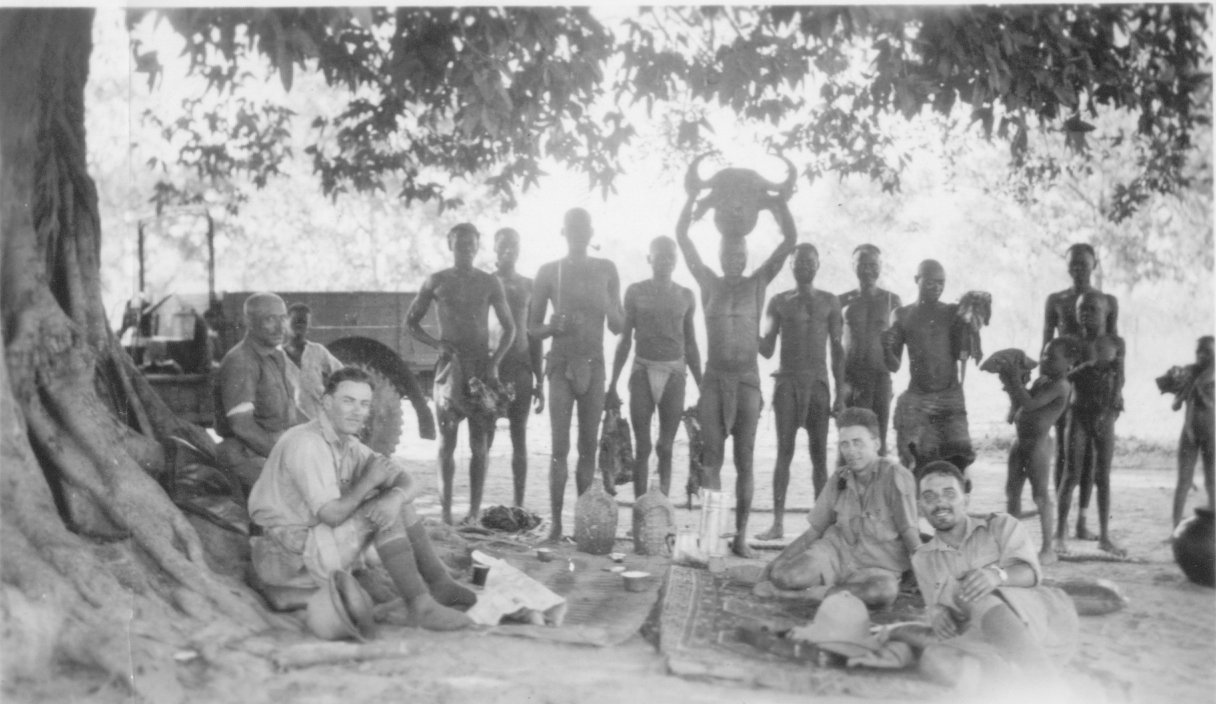 |
| Lt. Imbert at front left, other Free French not yet identified. Fort Archambault 1941. |
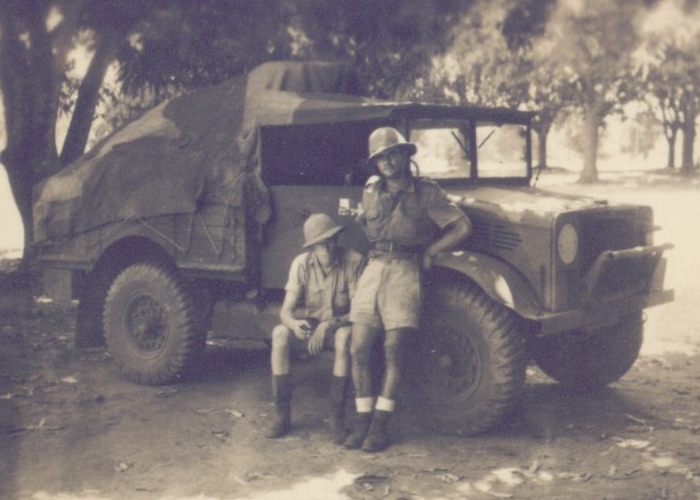 |
| Emmanuel de Beaussier at left with François René Tracqui, Bangui 1941. |
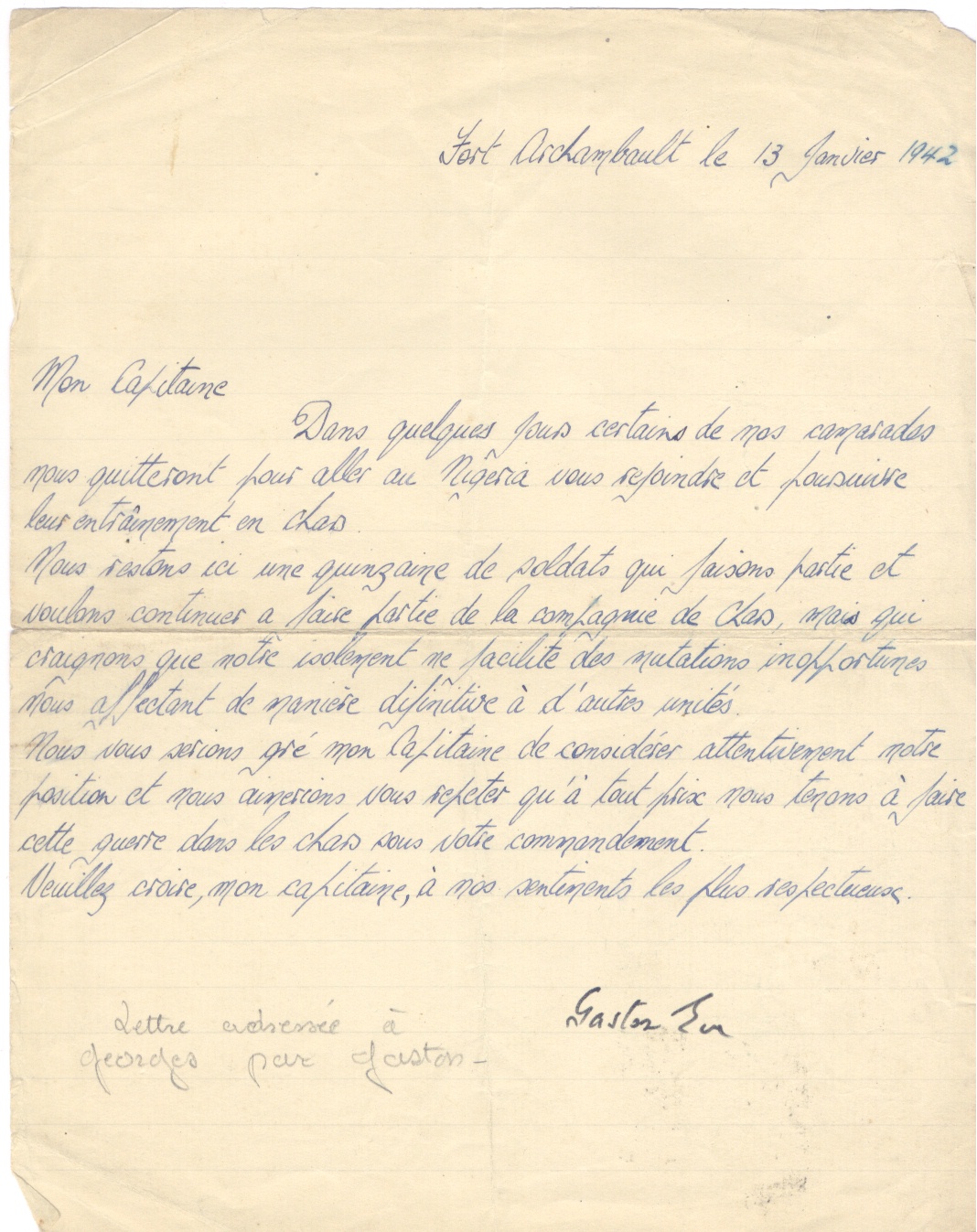 |
| Letter to Captain Ratard appealing for a return to his command, 13 January 1941. |
 |
| Free French lorries en route from Bangui to Fort Archambault, Nov 1941. |
 |
| River crossings were always by raft, Nov 1941. |
Pointe Noire.
Pointe Noire was a quite deserted place and we heard some say "Rather you than me". We were in British colonial kit but with Australian hats. I don't recall a thing about our reception at Pointe Noire but I think we were expected.
I found myself in a completely new world and it seemed funny to find myself in a place where, apart from a dock and a few cranes, there appeared to be nothing on the coast other than a beautiful beach and some wooden barracks in which to change to go bathing. We made a fair group because as well as our company there were the Chasseurs. We descended from the Northumberland by a small stairway that went all down its side. The boat seemed huge from the dock side. I don't know if the Jeeps and other materials were unloaded but I think they were.
The disembarkation soon done, our camp wasn't far away because it was right by the sea. It was consisted of wooden barracks occupied by sailors and for ourselves, some large tents. Each bed had its mosquito net. We had started taking Quinine while on board the Northumberland and for my part I never missed taking the recommended dose.
The camp made a very poor impression on me. There were many sailors but I don't think they were with us. If they were with us then relations between us seemed cool. We remained there for several weeks. I don't recall making a friend amongst the sailors. Most of them were a good deal older than us and I thought they drank rather a lot.
Drink was not a big part of life for us. There was something very fine in our general behaviour and it's something difficult to define. It was without doubt because we were so young and that a very special pact had been forged.
There was not much of importance to do while waiting to leave and so we formed small groups amongst us to go out to Pointe Noire or go to the beach to bathe. We were warned that we shouldn't swim far out from the beach because there were sharks. We had already seen some while watching from the Northumberland!
The camp was very dirty and poorly maintained. The latrines were disgusting and rarely cleaned. Then there were the wooden barracks. I have never again seen a camp so filthy. I had the bad luck of acquiring dysentery only 48 hours after my arrival, even though I had taken care to do as I was advised at night. We were told to wrap a long strip of fabric around our belly, it was supplied as part of our colonial kit. So I think I must have eaten something bad. It was a great problem and I started getting up many times each night to relieve myself. After some weeks I started to pass blood now and again. I had dysentery and that was not a rare thing in Africa.
I had some medicines now and again but the problem remained and all through my journey I sought local cures of all sorts, fruits, leaves, and so on. Almost three years later in Morocco it was fresh figs! I became inured to the problem and it forced me to use will power but inevitably I physically dwindled away.
I think that some amongst the Free French (tankers and Chasseurs) were separated and a party was sent toward South Africa and I think Syria. We were reunited a long time later at Sabratha.
We were dispatched by train to Brazzaville, so we left the sailors in their camp. We said our goodbyes to the Café Bleu and some little restaurants we had visited from time to time. I was glad to leave Pointe Noire. The journey by train was very beautiful because there was so much verdure. The train stopped from time to time and there were fruits to buy. I liked the Negroes a lot, I found them to be cheerful and friendly people. At Pointe Noire I was struck by the politeness of those that spoke French. When we went out or when we walked along the beach it was always "Bonjour monsieur".
Brazzaville.
Arriving at Brazzaville we were taken by lorry to a superb and very well managed military camp, Camp Colona D'Ornano. The pride of the FFL showed there. The food was very good and generously served and we were about four to a room. We were able to buy bunches of tiny bananas that were very good and many other sorts of fruits.
Brazzaville was a pretty little town. At night we could hear the sounds of drums and African music drifting from the Negro villages. I found that very beautiful.
We were all put through the military and medical services at Brazzaville, which were very good. It was all very orderly. Our military papers were put in order and it was here that I received the little tag that I kept all the war around my neck. It had my name, enrolment number, blood group and recruitment centre (Brazzaville!). Our Australian hats were exchanged for a colonial [pith] helmet but we kept the entire English colonial uniform we had been given before leaving Camberley. We gave those up much later when we had American uniforms.
The company [integrity] was menaced now and again. Men were needed for this or that duty and we had no tanks as evidence that we were a properly formed tank company.
A detachment was needed to leave for Syria or Lebanon. We lost comrades who were not given the choice; Jacques Passy, the son of an English officer; Maurice Jean-Renaud who had come from South America with Lieutenant Jean Davreux; Armand Peurier and many other good comrades. There was no choice. Our comrades and the Chasseurs suddenly departed very suddenly through southern Africa. I had the chance to rest.
We spent several weeks at Brazzaville and I had some medicines for my dysentery. In awaiting our departure we didn't do much, yet time passed quickly because everything was so new. Our behaviour was impeccable and it was an honour to be among such worthy comrades. We would go out on the town and when it was too hot we took a little cab [rickshaw] on two bicycle wheels pulled by an African. The Negro population of Brazzaville was very polite and agreeable and we reciprocated this. All the services were well organised.
We went to Leopoldville two times by crossing the great river that separated Brazzaville from Leopoldville. My memory of the Negroes of the Belgian Congo was that they were more advanced than those of the AEF. Their physique was also superb.
While we were at Brazzaville a young Swede of 20 or 21 years arrived among us who spoke French very poorly. I don't know where he came from or where he went to but I never saw him again after Brazzaville. His name was Ulf Raenar Guillaume Berg. We dormed together. I remember one day when he was sleeping for his siesta and he found a couple of lizards in his bed. The lizards really loved our beds. Berg was very attached to me and I did my best to help him. Selesko [Seleskovic] spent a lot of time teaching him French. Selesko may recall what became of Berg.
To Fort Archambault [in Chad] by Paddle Steamer and Truck.
Early one morning we left for the Fondère, a lovely paddle steamer of bygone days, to go up to Bangui. Attached to the Fondère were two barges with a number of Jeeps and lorries on board that we were to drive to Fort Lamy.
The European population was very kind on our day of departure from Brazzaville and came to see us off in large numbers. It was a great day for us as for them. I think we had some Chasseurs with us who were going to Chad. Our goodbye to Brazzaville remains a fond memory and the European population gave us a good send off.
The voyage on the Fondère was very pleasant. That paddle steamer was very well fitted out and the food excellent, served in a beautiful dining room. We had cabins but in general I slept on the deck. The nights were very beautiful. On the journey we were able to admire the forest lining the river and at a distance one could see many types of monkey in the trees. Some were enormous and all this was novel.
Now and again we would stop to take on some wood for fuel and at these times many Negros from along the Congo side would come along in their canoes to sell us all kinds of things [carved] in wood or ivory. Their workmanship was very fine and we would buy souvenirs as if we were going to soon return home.
It was very agreeable when we would stop by the riverside and we could get back on land. At Pointe Noire, Brazzaville and other such places Lieutenant Michard was always very interested in the Catholic missions. At one of the stops for fuel and supplies on the French side of the river we went to a very pretty one. I went with the Lieutenant, who had been a student priest before the war. We came upon its beautiful buildings amidst a very broad and calm setting. He greatly appreciated this and spoke at length with the fathers. It was very beautiful.
The journey to Bangui, which was against the flow of the river, took about a week and was very pleasant [ Emile Fray has kindly pointed out that it was in fact a 12 day journey. The boats travelled only by daylight because of dangerous sand shoals. ]. Arriving at Bangui we unloaded our Jeeps and lorries and entered another beautiful and well cared for camp. There were other lorries and jeeps there beside those we had brought. I have two very vivid memories of Bangui. One was the cold showers, always so cold it was unbearable. The water came from the mountain! The other was the dining room that had a phonograph with a few records that I loved to play. We would spend the evenings talking together and listening to the records on the record player in that canteen. One of our best companions was a game of Monopoly that a comrade had brought from England.
We didn't stay at Bangui for very long ( a week or two ). We went out, two or four to each jeep and took turns driving. We made a lot of dust! On the outskirts of Bangui they had lions that would walk along the streets and I suppose they had eaten well, because they were not interested in us at all. There were many gazelles and by necessity we killed them to eat because we had no meat in our diet apart from corned beef. We were not unhappy with regard to the food.
When we were in Leopoldville Henri Caron purchased a large case of bottles of Congolese beer, which he shared with us. I didn't drink spirits but I drank a little beer when we stopped for the evenings along the route we took to Fort Archambault.
I still had my dysentery and I was prone to headaches. Henri Caron would watch over me and give me a little of his beer of an evening. Now and again Lieutenant Michard would tell me I needed to drink a little spirits but I couldn't keep it down. The Lieutenant had a bottle of Curacao liqueur and I drank a little from time to time.
Now and then we would pass through a Negro village and when we stopped we were always welcomed with drums and so on. The men and women were very fine and gay and loved to laugh. Now and again we encountered a European but that was always rare. I don't recall how much time we took to get from Bangui to Fort Archambault, but the vehicles were still running in and it took several days. We departed in small groups of four or five vehicles at intervals of several days. We were reunited at Fort Archambault.
Fort Archambault.
Fort Archambault was a nice garrison town with not a few European civilians. It had beautiful vegetable gardens lining the river and some nice little native shops.
It was here we encountered a company of the Regiment de Tirailleurs Senegalais du Tchad [Regiment of Senegalese Riflemen of Chad] who were to stay with us for a long time, up to our departure from Nigeria. They were very well built and very disciplined. Their sergeant and his captain had tremendous authority. I recall the sergeant at first had his two or three wives and their children with him, but when we had to leave for Chad they had to remain behind.
During our stay at Fort Archambault the material we had with us allowed us to give driving lessons to some riflemen. The first lesson was the difficult one. Many of the roads had trees along them and we soon realised the need to give driving lessons on roads with no trees of any sort.
I don't know why Fort Archambault was another problem for our company. I think it was necessary to keep up the numbers in rifle companies. The greater part of our company was again immediately told to leave for Fort Lamy but a far smaller group among us was left behind. It was difficult to accept the separation but there was nothing we could do. We were told we would be going to Fort Lamy later.
While I rested there I employed a "boy" to do my washing and cleaning. He was a lad called Guéché and he evidently had a venereal disease even though only 16 or 18 years old. He was very nice and the money helped him. I spent almost nothing of my pay and when we left I gave all my money to him, about 600 Francs. He came to see my lorry off with many a "Merci Monsieur." I hope he had a good life, he deserved it.
Those who stayed at Fort Archambault were: Lieutenant Imbert, Frédéric Rio, Gaston Eve, René Leleu, Leon Baudon, Creusat, René Alençon, François René Tracqui (dit René), Michel Huguet and Milano Maurinkovic. Apart from Lt. Imbert we were in a large barrack made entirely of straw and large leaves. It was thoroughly African. The amenities were very basic.
After our comrades left for Fort Lamy the comrades that remained asked me to write a letter to Captain Ratard explaining that we had hoped to pass the war under his command and asking him to call for us. This letter was taken to Fort Lamy for us by hand by a person who was going there. [ To avoid the regular postal service and military censors ! ]
Life at Fort Archambault was very monotonous but we passed the time for better or worse. We did our best to keep occupied. In the evenings we would go bathe in the river that ran the length of the town and had to keep a careful watch for crocodiles. The water was not very clear but it was better than nothing because it was so very hot. I didn't have many distractions, not drinking or smoking so I bought a complete series of postage stamps of Free French Africa, which I've always kept and later a second series of Free French Cameroon.
A really beautiful lorry that had served as for driving lessons for the riflemen had been driven into a tree or a wall and wouldn't run because its front was bashed in. We hadn't done anything wrong but Huguet and I asked permission to try and repair the bodywork and each day for many weeks we worked on it. There was a shortage of the tools necessary but we succeeded in straightening the bonnet, wings and so on, not too bad. It took a lot of will power to keep going because it was hot. Despite all our persistence we left Fort Archambault without completing the task because it was thoroughly dented.
One night while we were sleeping, each under his mosquito net, the whole row of us awoke simultaneously because we were being attacked and bitten. It was an attack of huge black ants that caused intense pain. We evacuated the barrack without aid of lights. In the moonlight we saw they came from all round in many long columns. By daybreak it had still proven impossible for us to make them change route. We would stop them temporarily by crushing them with our feet but those following would continue up to them so that there was a mound of ants as large as a football. After that they would pass the side and recover their route.
They were in many strands and we had to use petrol on them, there was no other means. We were killing enormous quantities of them and after about an hour or two their progress was halted. They never returned into our barrack, but our first battle had been with ants and it was a defeat!
Some weeks later we were moved to a brick building towards the centre of Fort Archambault. Happily for us one of our comrades had left behind his game of Monopoly. This greatly helped us to pass the time. It was always very hot in the day and very cold in the night and I always wrapped the band of cloth around my midriff at night. I had some medicine for my dysentery and this helped me a little. Speaking with the colonials I learnt that the indigenous people made a special beer that was good for dysentery. I went to a small village close by Fort Archambault to buy some from time to time. It wasn't very appetising but I needed to find a solution even if it only worked half way.
The weeks passed and we kept waiting. Lieutenant Imbert checked on us constantly. I think that Staff Sergeant Raveleau was also with us. We were a very tight little group.
An Excursion to Mongo.
One day Lieutenant Imbert told me that he had chosen me to accompany an infantry captain, an NCO and a dozen riflemen to go for men to form a rifle company. He told me that we would be gone about a fortnight but that he and my comrades would still be there on my return.
The news was good because life at Fort Archambault was very monotonous. It would also be an epic journey because we would be going from Fort Archambault to Mongo, which was close to the border with Sudan. I think it made 600 to 700 kilometres, double that altogether to go and return. We departed in about ten American Dodge trucks. The trucks were driven by professional Negro drivers. There were no roads, just simply tracks. Ironically the greatest discomfort for me was that the trucks seats had very good springs so on the rough tracks we bounced and bounced on them. It was like that the whole way.
We had provisions for ourselves and more to deliver to Melphi where there was an administrator and also to Mongo. We also had water and all the petrol needed for the voyage out and back.
We were en route early morning but it very quickly became hot. We stopped for a lunch breaks and finish our day before nightfall. It was a very monotonous journey because for the greater part of the time there were very very few villages on the way. We saw many wild animals and on two occasions great caravans of hundreds of laden camels. The noise of our engines was not good for these caravans because the camels became frightened. On those evenings we stopped in a village and were received with great curiosity.
The captain would take a seat from his truck and sit in a place of prominence to receive the chief and other dignitaries of the village. One of the riflemen would do the interpreting and all went well. When it was a large village the chief would have his retinue and it would lend great colour. It was an event for them as well as us. The captain had brought along presents in expectation of these occasions and I think he received some also but I don't clearly recall. For me, it was very impressive. For the captain who had been in the AEF since way back it was just routine and he played his rôle with dignity.
We ate rather late on those days, before a fire by the light of the pressure lamps [Tilly lamps] we had with us. We had a folding table and chairs for us three and there were always many men, women and children of the village gathered around who would watch us eat. Everyone was very gay and those watching us would laugh and enjoy the little pranks we played from time to time.
Other than my colonial uniform, I hadn't brought anything warm to wear in the evenings when it would become very cold, as it always did when we were in mountainous regions. The captain, seeing that I was cold, gave me his sheepskin to wear each evening. Nights under the stars with one or two riflemen on guard, were very pleasant.
Before arriving at Melphi we came to a place with a huge house made of straw and leaves all surrounded by a high fence of local material as protection from the wild animals at night. I don't know what the [ European ] man and woman were doing there. They had some Africans with them and when we arrived they went and hunted a wild pig. They served us a very nice meal.
Our arrival at Melphi after being well shaken over so many days was very welcome. Melphi was quite large and it had a French administrator living in a beautiful African house. I think he had a good life because the house was pretty and well furnished and he had servants and cooks. We rested there for two days and he received people individually or in groups in his office.
The cooking was very good and the servants were uniformed. Meals were very enjoyable. He had a very pretty lady from Cameroon with milk coffee colour skin with him and he seemed fond of her. She came and went [ freely ] in the house and ate with us. She had a beautiful face and was respected by him. I don't know what he did when his tour of duty was over.
Melphi was on a plain in a rocky mountainous area. It was beautiful to see Melphi in the middle of all that. It had water and everybody seemed in good health amongst the population. The administrator had a phonograph with some records of classical music and a piece with violin, which I liked a lot. It sometimes comes back into my head but not at the moment I write. It will certainly come back. [ He was fond of "Meditation" by Massenet, I think that may well have been the piece ]
We left for Mongo on a track through a very very deserted region. I think we arrived at Mongo in two days. Mongo was a small, entirely native village surrounded by rocky hills and seemed poor even though the African men and women were of very beautiful physique. There was one European at Mongo and I think he too was an administrator. His home was far less pretty than that at Melphi but it was cool.
We arrived in the night and they must have seen us from far away with our headlights! The next morning the captain put his chair in the middle of the village and asked to see the chief, who then came accompanied by his entourage. The captain told him that we needed some men. Hundreds of the men of Mongo were then assembled in the middle of the little African town and I remember this activity with sorrow, though it was done very quickly. After the men were put into ranks their chief talked to them, then they suffered the indignity of having to remove all their clothes, (generally a pantaloon or a long robe). The captain and sergeant went along the rows, some had considerable deformities and so he chose the physically fittest and they were put in a corner.
This done, the others departed. I should explain that there were a lot of women and children there. They were dressed in their finest with beautiful African coiffure.
It had evidently been decided that the choice having been made, the men must leave immediately, otherwise many would not be found the next morning. The trucks came. The riflemen were mounted in the trucks with a very authoritarian look, rifle in hand. There were two or three riflemen per truck. Seeing this the crowd of African women rushed around the trucks and started crying and making African wailing noises because they were obviously going to be immediately separated. They ran around the trucks trying to retrieve their husbands and sons. The men for their part, were trying to say goodbye with dignity.
We left in just a few minutes amidst all these cries and a flood of tears. The women started running after the trucks as far as they could. I have never again seen such a sad scene so brutally accomplished. Our return to Fort Archambault was quite different, with as few stops as possible. The evening when we stopped it was in the brush, not in a village. I think because otherwise we would have lost our men, who slept within a square of trucks with many riflemen on guard. I don't know what became of these riflemen but I hope they returned to their homes after the war and resumed their lives.
We passed through Melphi stopping only for a few minutes (perhaps an hour). We arrived at Fort Archambault in good time. The journey was very tiring because of the tracks we travelled on. Everyone was very dirty and covered in dust. The natives were all very tired from all that movement in the trucks.
Back In Fort Archambault.
After these days together I learnt to recognise the men of Mongo and they recognised me. During the two or three weeks I was at Fort Archambault before leaving for Fort Lamy I would see them now and again in the street. They were very fine in their uniforms and I thought that they were content. Some amongst them had learnt to salute but they hadn't yet understood that they should salute whilst still marching. When they saw me coming they would halt some distance away and give me a smart salute, which I would return. After this they would continue their march. It lasted like that for some days.
I keep a lively memory of the men and women of Mongo. They had great hearts. I hope they found there way home at the end of the war and that their women could cry tears of joy and wail for the same reason.
Those of us who remained at Fort Archambault spent Christmas 1941 there. We had brought three or four bottles of wine. We had Alençon with us and he made a little Christmas dinner. We made a little Christmas tree by putting some cotton on some dry tree branches. We ate together as we were now accustomed under superb moonlight. That was my first Christmas with my comrades on December 1941. It's the only one I can recall.
During our stay at Fort Archambault they had some large native fêtes and I found the ambiance, noises, drums and simple musical instruments very interesting. I was always drawn to the atmosphere of these occasions and I keep a fond memory of the little girls and naked young women who approached the tribal chief and his entourage dancing and chanting. These occasions had tremendous colour and lasted many hours.
We carried a radio and the reception was very good at night. We would listen to the news from London in French preceded by the sound of "V" on drums (di di di daaaah) as in the 5th symphony of Beethoven, which even now evokes a strong memory. The news was very bad. My morale was always good, but I asked myself if we would ever go home. The Germans were at Moscow, Stalingrad and so on. It was retreat in Libya. It did us good to hear "Les Français Parlent Aux Français" and it boosted our hope, but the road was going to be very long.
I had the luck to receive some letters from my parents. My comrades didn't have the same luck as me. I've always admired their fortitude. I made a point of giving them confidence, never showing despair or a lack of confidence in our ultimate victory.
To Kano Via Fort Lamy [Ndjamena].
After several months Lieutenant Imbert told us that we were going to rejoin the company. We had talked amongst ourselves from time to time and had decided that come what may, we would accept nothing else. We were happy at the news and departed for Fort Lamy with some equipment that had arrived in Bangui.
As with all the movements in Chad this was in a great cloud of dust. Fort Archambault was a garrison town [so we left] without the grand seeing off of Brazzaville. We left in a convoy as if we had been doing it all our lives.
We all paid close attention to wearing our colonial helmets all the time. I have a vivid memory that between Bangui and Fort Archambault one of the lorries broke down and a mechanic removed his helmet to get under the lorry in order to repair it. He felt nothing at the time but a few hours later he felt unwell having suffered sunstroke. A day or two later he was dead! I think it was a young lad called Omnes [Joseph Omnes]. Wearing of a helmet was absolutely done after that.
It was a pleasure to arrive at Fort Lamy which was a town much more important than Fort Archambault. Military life there was well organised, very precise and clean. We stayed for several days. All the company was at Kano and someone informed us that the new tanks had already arrived there. That was truly great news.
The manner of our journey was not complicated. We had no transport other than a Nigerian company, with native drivers, who transported all kinds of materials Kano - Fort Lamy - Kano. The lorries were completely packed. Our sole means was to place our kit bag on top of the stuff already on the lorry and sit on top of it all. I was able to speak a little English with the Nigerians and that was nice. The distance was great and this was not the most comfortable of voyages, but we faced up to it without complaint.
In the evenings the lorries would halt at a place pre-arranged for transports. Alençon would make us something to eat then we slept soundly. It all took a lot of determination, the sun beat down hard and the dust was thick. These were tracks, not roads and we were thoroughly shaken.
Gaston Eve.
