
Information from "L'Odyssee de la Deuxieme Compagnie de Chars" Editions Lyonaises by General Jacques de Witasse :
Both the battle for Italy and the allied landings in south France included a large contingent of French colonial troops with the Première Division Français Libre attached. Leclerc refused to have his Division attached to an "ex-Vichy" army.
The 2me DB was instead allocated to General Patton's Third US Army, to be precise to 15 Corp along with US 5th Armoured, 79th & 90th Infantry Divisions, all under command of General Wade H Haislip, an american educated in Paris and fluent in french.
1st Aug: Land at Utah Beach, then on to St Mère Église, Le Hay du Puits, then along the Lessay-Coutances road through the Lessay gap. 6th Aug: Reach Coutances. 9th Aug: Reach Avranches. 10th Aug: Depart Avranches at dawn, reach Chateau-Gontier then Le Mans, only liberated hours earlier by the Americans. 11th Aug; Depart Le Mans in the morning, pass several destroyed tanks of 12th RCA ["Régiment Chasseurs D'Afrique"]. Bivouac overnight. 12th Aug: Cross Alençon on an unauthorised dash for Paris but were rapidly called back. A unit is detached and at 6 pm that same day sent from north to south through the Forêt d'Ecouves to rendevous with 1st RMSM, commanded by Roumiantzoff, who was already crossing the forest from the opposite direction (south to north). The RMSM had encountered German armour hidden in the trees and things were getting hot. 13th Aug; On the evening following the fight in Forêt d'Ecouves, the unit is put to rest south of Argentan and spend the next 10 days blowing up Germans trying to escape from the Falaise pocket.
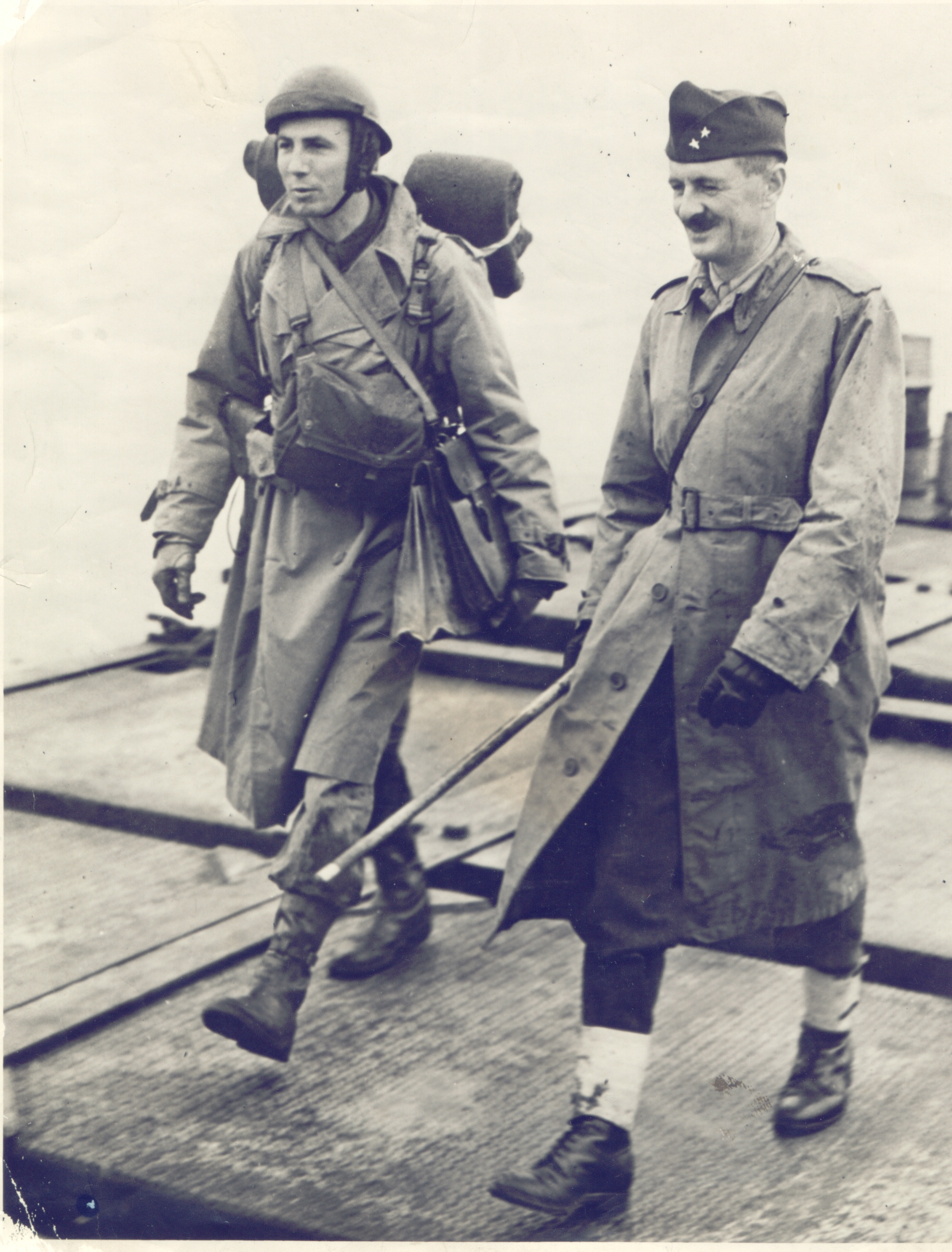 |
| General Leclerc arrives on "Utah beach" Normandy. |
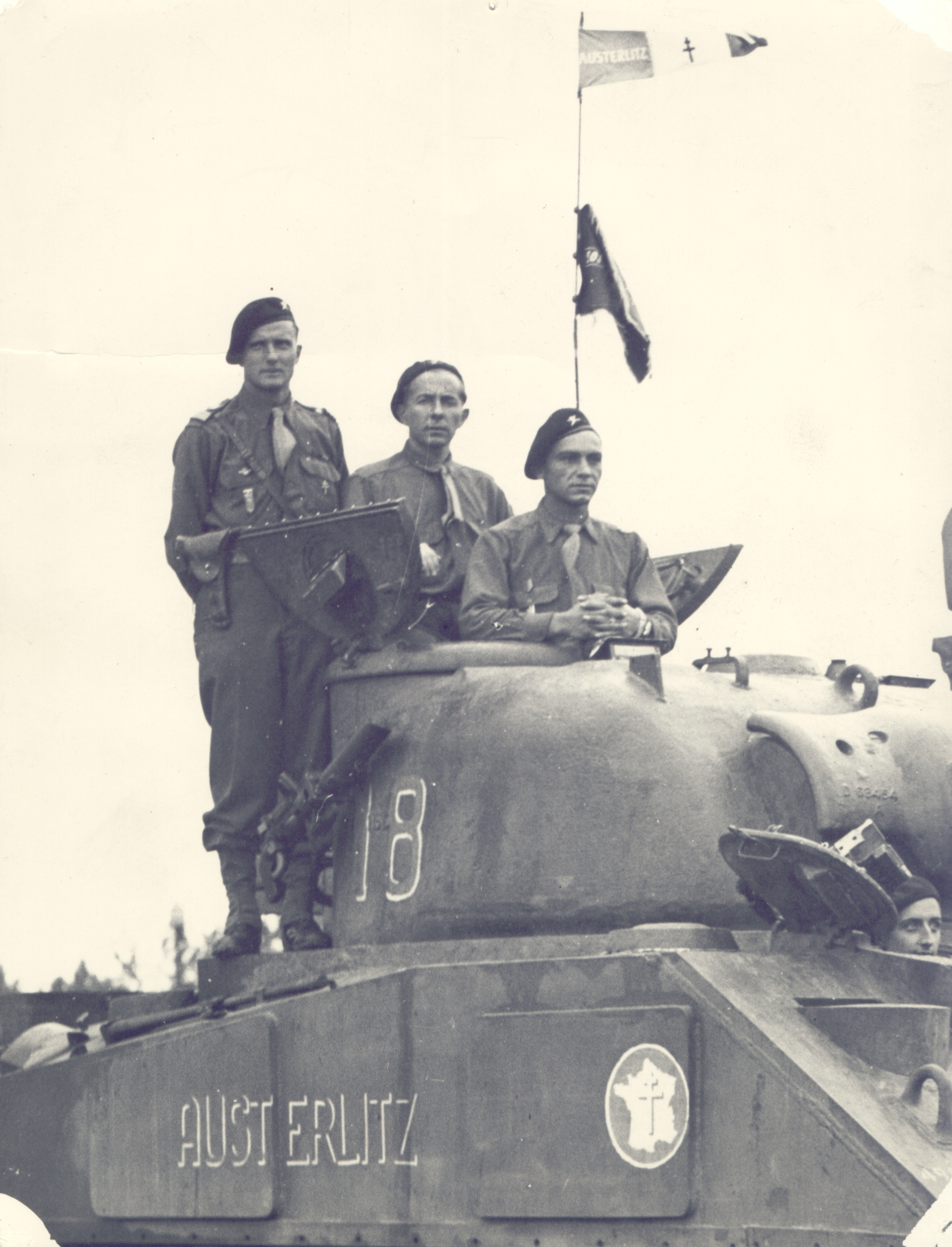 |
| Far left Captain Jacques de Witasse, company commander. |
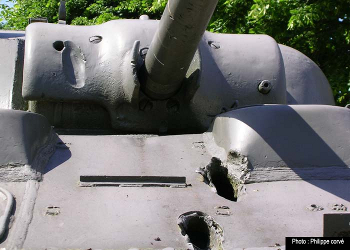 |
| The front of the original Montereau, preserved at Alençon. It was pierced by three 75mm armour piercing shells. |
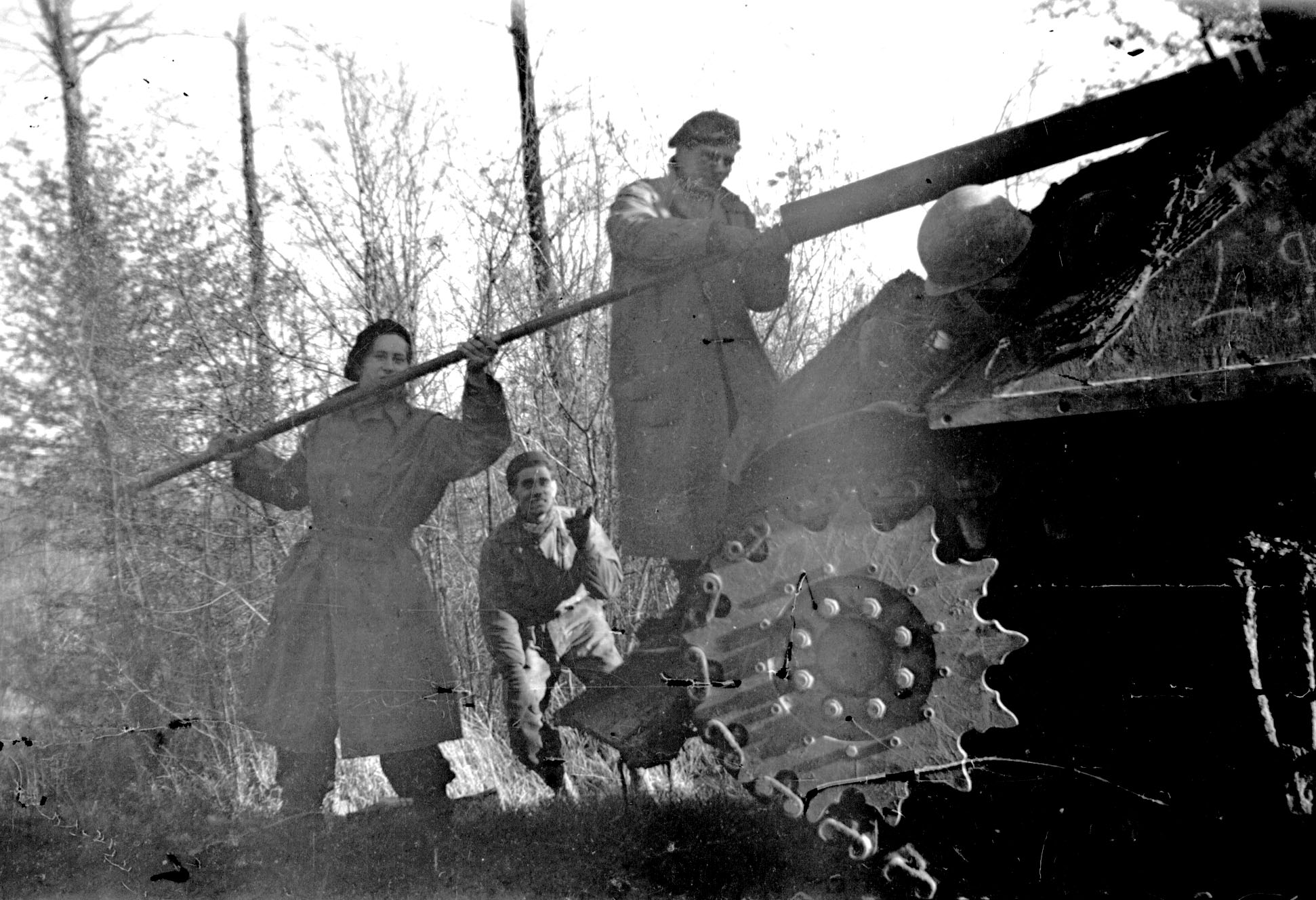 |
| Routine maintenance, cleaning the cannon of one of the company's tanks. Men not yet identified. |
England.
[Sadly 18 pages of notes are missing at this point spanning Gaston's training in England through to the first 9 days in Normandy. Emile and Mary Fray have very kindly allowed me to borrow some pages from Emile's account of his war experiences to bridge the gap. Emile and Gaston travelled almost the entire war from Camberley to Berchtesgaden together in the First Platoon of the Second Tank Company. Emile commanded Champaubert on its journey from Africa to Yorkshire and then transferred as radio / gun loader for Montereau then Montereau 2 for the european campaign. The top half of this page is therefore © Copyright 2008 Emile and Mary Fray.]
Port Talbot.
Finally we arrived safely at Port Talbot, South Wales. Unloading was just as efficient as the loading had been. As we disembarked we were divided into different units, then given a parking area for the night, ready for our journey next day, by road to Yorkshire.
Sleeping was a case of putting your head down where ever you could. In the tank, under the tank, anywhere that was available. Before settling down for the night we decided there was time to get some sort of refreshment. We had been issued with English money as we landed. Legally we were not permitted to leave the area, there was strict security imposed, but it was not too difficult to find a way out and a large group of us headed for the nearest pub.
We crowded into a pub filled with Welsh dockers. Again my English was needed to order the drinks. Soon there was a very good relationship between the locals and us, many of our boys from Brittany could speak the Gaelic language which was the same as Welsh. A loud rendering of the Welsh song "Au Braes Ma Beau" could be heard all over the town.
I was in conversation with one of the dockers, when I had an idea! I asked him if he would be kind enough to send a telegram for me, to my girl friend. I wrote down the address, told him what to say, and gave him half a crown (two and six pence, about 4p today). He readily agreed and I passed over the money. I knew I could not write as all letters were censored before being sent out. Any reference to towns, troop movements, place names etc were cut out, so when the letters arrived they were full of holes where the offending word had been.
It was nice to be on land again after such a horrible voyage, every one agreed the evening had been extremely enjoyable as we found our way back to the tanks to put our heads down, wondering what tomorrow would bring.
Half of the convoy which left Casablanca had disembarked at Swansea, as there was not sufficient space to keep us all together. We set off in convoy for Yorkshire. Two British military police on motor cycles were to take the lead, to control the speed, also to insure we kept on the right route. Many of the roads were narrow and winding. By trying not to disrupt the civilian traffic too much we were spaced out, with several yards between each tank.
Several miles on, at a given point the rolling stock, tanks, lorries, artillery etc, all came together and was made into one huge convoy which stretched for miles and miles.
As commander of my tank I stood up in the turret watching the signals given, which I then relayed to the crew through the intercom. Travelling at a very moderate speed, covering only 65 miles each day it took us 5 days to reach our destination. Each night when we stopped all the crews needed treatment for sore eyes. Although we wore goggles the dust and the diesel fumes from the tank in front caused a problem.
Huggate Yorkshire
When we arrived a Huggate, a small hamlet set in the Yorkshire moors, every thing had been prepared for us by the British Army. Hundreds of tents stretched out over a large area of the moors and mobile kitchens were ready to serve us food. We were billeted 8 to a tent, as corporal I was in charge of one for our crew. Huggate was very small village, no shops, one pub, which was out of bounds to all of us. The nearest town Pocklington was 11 miles away, Hull 25 miles, York 25 miles.
There was a lot of work for us to do. Every tank was to have extra heavy metal plates, each one and a half inches thick, welded to the sides to give the crew more protection against enemy shells. A badge of the division and a name for each tank had been designed at Headquarters. The badge was a map of France in blue, with the Cross of Lorraine superimposed in gold. The names for the tanks were all names from Napoleonic battles. A reshuffle of the crews was being made. Up until now my tank had always been the "Champaubert" and my friend Roger was in the "Montereau". Now Roger was delegated to the "Campaubert and I was delegated to the "Montereau" as a radio operator and gun loader and when necessary to be the heavy machine gun operator. This change over was to have a very devastating effect on the life of both of us in the months to come.
Having found out exactly where we were situated, I sent a letter to Mary asking if she could get time off from her war work to come to see me. I told her to come by train to York, then a bus to Pocklington and by taxi to Huggate. I explained I had found her lodgings with an elderly lady in the village who had a room to let. Within three days I received a letter from Mary but it was not the answer I expected. Yes, she would love to come to see me, but had no idea where I was. My letter had passed through the censor on the camp and every word I had written with a place name had been carefully cut out, leaving lots of little holes in the paper, but not a clue as to where I was.
I was talking to an English soldier who was working at the camp, when he mentioned he was going on leave to London. I then had a brain wave. I asked him if he would post a letter for me when he got there.
"Yes" he said, "no problem."
I wrote another letter giving all the details, as before and hoped this time it would arrive intact.
Sure enough, I received news Mary had permission to have ten days off work and would be arriving the following week. I explained to my commanding officer that she was coming, hoping I could have a few days leave. No leave was possible but as a special favour he agreed to let me be in the first batch each day to do firing practice then I could have the rest of the day off.
I was working on the tank with the rest of the crew, my hands covered in grease, when suddenly a loud cheer went up. I looked to see what had happened, when some one called out,
"Emile there is a girl here to see you."
I ran to the road and there she was, looking radiant, wearing a scotch glengarry jauntily on her golden blonde hair and big smile on her face. We embraced warmly, much to the amusement of about 150 men who had stopped work to watch us.
I had permission to leave camp for 30 minutes. I took Mary to the cottage, introduced her to Mrs. Able then left her to settle in. That evening after a wash and brush up, we met, we talked and talked, so much news to catch up on and before the evening was over I asked her to marry me.
The answer was "Yes."
We arranged that we would go to Hull, on the one and only bus of the week, to buy an engagement ring. We found a jewellers and chose a solitaire diamond ring, then celebrated with a cup of tea and a cream cake in a small teashop.
The ten days passed all too quickly. It was time to part, not knowing when we would meet again, but this time we had a firm bond between us. This was to give us hope and courage to face the future and the long lonely days ahead.
Leclerc had been given Dalton Hall for his headquarters during our stay in Yorkshire. He was extremely pleased to inhabit this beautiful English chateau. It reminded him so much of his own beloved chateau in Picardy. Here in the quietness of the surrounding English countryside, with views over the charming gardens, he could relax for a short while. In the evenings he would stroll into the library, selecting a book from the hundreds of titles which ranged from floor to ceiling on all four walls.
Another reason he was happy was he had been informed that his crack 2nd Armoured Division was to be attached to the 3rd American army, under General George Patton. Leclerc knew Patton would lose no opportunity to attack and that was his way of waging war too! A very flambouyant man, he had been educated in France and studied at the École de Cavalerie at Saumur.
I had seen Patton when he first came to inspect us. He arrived wearing a gleaming lacquered helmet and two pearl handled pistols in his belt.
Four of our tanks had been placed along the shoreline at Bridlington. Each day several lorries left camp taking us to do firing practice with the heavy guns, at moving targets out at sea. This was to leave the tanks in position at camp, so not putting any unnecessary mileage on the motors. All the tanks were in perfect condition, the engines were greased and cleaned, every nut and bolt shone, the tracks were gleaming. There was a small petrol motor situated near the turret which we nicknamed 'Little Joseph' this was used to charge the tanks large batteries while we were resting.
Each crew was proud of their own tank. We were all determined that every thing would work well and we would not breakdown, to be left behind when the word came for us to go.
June 6th 1944 dawned and the whole world heard that the landings in France had commenced. We were very excited about it but we knew it would be necessary for the infantry and light artillery to get a strong foothold on the beaches before we could land.
We learned that Free French commandos had been in the very first wave of troops to land. That made us all very proud of those brave men who knew their chance of survival would be very slim.
With the millions of men that had left the shores on the south coast there was now space for the heavy artillery and tanks to take up position ready for our turn to go. We left the moors of Yorkshire, travelling in two long convoys. One convoy headed for Southsea, our route took us to Southampton. Here we waited for two weeks, unable to leave camp, strict security everywhere. We were certainly not allowed to talk to the civilian population. There was fear that if the Germans became aware of our plans, we could have been bombarded by air attacks.
Utah Beach, 1 August 1944.
On the 30th July 1944 the LTS arrived back into port. During the afternoon we were loaded with the same well organized precision. It was amazing how much thought and planning must have gone into these operations to move thousands of men, hundreds of tanks, half tracks, lorries, etc. Each company had its own allocated slot and every one fitted into place just like pieces of a jig saw. By the evening we were ready to go.
All through the night we sailed across the channel. Every one became quiet, wrapped in his own thoughts of families, friends, wives and loved ones. We had been away for five long years and knew nothing about how had they fared under German occupation. Likewise our families had not received one word of news from us, They had no idea what had happened to us, or even if we were alive. There had been terrible bombing raids, tons of explosives had rained down on to the towns and countryside, clearing a way for the troops, but how many people had been killed? We did not know.
It was traumatic and distressing, at the same time exhilarating to be going back home to our beloved France. The sea was quite rough, we tossed and rolled , the heavy tanks straining at the chains. Then just as dawn was breaking on the 1st of August we felt a bump. We had landed in shallow water on the shore of Utah beach.
The large doors slowly descended outwards creating a metal ramp for us to disembark on to the beach.
As the engines roared to life General Leclerc was the first ashore, striding up the metal strips, jabbing his cane into the sandy soil of France as though to prove it was real. As soon as we had disembarked into the shallow water and crossed the beach, several tanks pulled out of line with the crew jumping out, kneeling down to kiss the soil of our beloved France.
There was not much time for the sentimental gestures, we were pulled back into line and the column began to move. The first little hamlet we came to we saw a farmer smiling at us as he herded his cows along the field. Waving his cane he called,
"Vive l'Americans".
I called to him saying in French "We are French soldiers and there is a whole division coming behind us."
He looked in amazement and thought I was joking.
We set of on the road passing through Ste Mère Église, St Martin and other small coastal villages until we came to the main road at Le Haye du Puits. Here we continued down the Cotentin Peninsula to Avranches.
[ End of Section by Émile. Gaston's story continues below, preceded by three paragraphs copied from some undated pages at the back of Gaston's 1944 Diary. ]
St Mère Église, St Saveur, Le Haye du Puits, Périers, Carentan. These towns are almost completely destroyed yet people remain to greet us and throw flowers. The greater part of them are in mourning. At Périers we distributed some supplies since these poor people have truly suffered. I ask my self where do they live ? Along the roads there are many dead horses and cows, all of which smells awful, the Krauts also don't smell good but we touch nothing because the Krauts have left mines, even under the dead in order to fry anyone who comes to bury them. The civilians tell us that the Krauts knew they were beaten, they looted a lot before leaving for Avranches - Ducey.
That makes two nights in a row that Kraut planes have come around here, fortunately it ended about two in the morning and we slept a little. The Krauts sent some parachutists but it went very badly for them because their armoured divisions have suffered badly. The civilians are evacuating the surrounding towns because when it isn't the American aircraft it's the German artillery that bombards them.
I've a lot to write but don't have the time. So many things are happening that it's difficult to recall. Everywhere we go there's hysteria. Everyone shakes our hands, gives us Calvados, cider, wine, some even gave us Champagne to drink. When we stop in a town everyone falls upon our tanks. What will happen in Paris? Hope to arrive there the 12 August.
The Forest d'Ecouves.
Reaching the Forêt d'Ecouves we learned what war was really all about. It was late in the evening and ominously dark when we entered the forest and most of us had a foreboding of what we were in for. We could only advance along the road because the trees and undergrowth were so thick around us.
Suddenly I saw three comrades coming on foot towards our tank. They walked like sleepwalkers and as they passed by the side of Montmirail I was able to see that the skin of their faces seemed glossy. It was later that I realised that this was the effect of burns.
My section then passed to the head of the column Montereau, commanded by Sergeant Jamette, and close in behind Montmirail. Lieutenant Michard, always self controlled whatever the circumstance, manifested his satisfaction at being 'in the action' with sonorous bursts of laughter. Looking into the trees I noticed Captain de Witasse on foot, making a reconnaissance. This was a wonderful Company Commander! Having witnessed what the Captain was doing for us I remained completely calm. As we passed the side of Elchingen [The original lead tank] I saw that the cannon had been literally torn off by an impact from an armour piercing shell. It was evident that ahead of us awaited a marksman.
All of a sudden two jets of flame shot out towards Montereau, one from within the forest, the other from the side of the road. A stream of sparks shot up out of her turret. I heard: "Ahead of Montereau Mécano!" (In combat Lieutenant Michard always called me Mécano). I manoeuvred and Etienne Florkowski let off one or two armour piercing, no more. On advancing I saw Jamette on the front of his Montereau and advancing towards him, up to his tank, a German without a helmet. Jamette took his pistol in hand and shot the German in the head in the heat of the moment. The pilot Tréguer was trying to get out, tugging his satchel. Jamette stooped over the co-pilot's open hatch, pulling him [Wiczinski] up by the hand, because he was probably wounded. Then there was a second explosion in Montereau as she roared up into flames and masses of black smoke, which killed Wiczinski, and all that Jamette pulled away was the man's arm. Then I saw, and I could hardly believe my eyes, a man's heart on the ground near the smoke and flames.
From our right came two other shots and I felt a light jolt within Montmirail. Lieutenant Michard was bleeding from the head, but still giving his orders to Florkowski. It was absolutely impossible to tell from where ahead the tanks were giving fire. Then I heard some more explosions, later I realised they were impacts from bazooka shots. Then silence....
Our infantry had gone into the woods to support a wounded trooper and we were told it was over, they had destroyed two [enemy] tanks and now our comrades were clearing the area. We were very lucky with our infantry who were most brave in their tank hunting. We had a tremendous feeling for them, for quite a few, like us, had been in from the beginning. At this time the Spahis in their armoured cars certainly had a terrible time.
We got out of Montmirail. Lieutenant Michard was bleeding profusely from his head, however he laughed. "It's nothing. It'll be fine with a dressing". But within a very short while the dressing was soaked in blood. Climbing up onto the tank I observed that an armour piercing shell had chipped the top of the turret's armour and these shards of metal had wounded the Lieutenant, who always fought with an open turret. What good luck he had! This was his second wound in combat. The blood ran down onto his collar and the Captain accompanied him to the rear of the column with a comrade of the RMT ["Régiment de Marche du Tchad"], wounded in the legs. It was he who saved us by destroying the German tank before it could adjust it's aim of fire. Lieutenant Michard kept smiling and said "I'll be back tomorrow."
It was then that I encountered Tréguer carrying his satchel over his shoulder, because as instructed at Rabat, we had been told to hold onto our satchel when evacuating the tank. After that the column moved on again. We knew that General Leclerc wanted us to press on as fast as we could so we did.
The morning of the next day I went over the ground of the previous days events (within 200 yards of a crossroads, which I later discovered was called the Crossroads of the Coffin). In some places I found four or five tanks knocked out in a matter of 100 yards. German tanks or Tank Destroyers had been waiting in hiding all along the route. In the Montereau rested our comrade Wicinski, a handsome young man, fair with bright eyes. [He was a Polish volunteer.] We passed by the side of Elchingen where rested the bodies of our comrades Raymond Pouille and Louis Tilly. Seeing the shells embedded in the tank it seemed beyond hope that three of the men could have survived. I had a good look over two of the abandoned enemy tanks. In an enemy vehicle I found a silk scarf, which I have kept ever since.
It had been something of a shock to find the circumstances under which we were expected to fight. The leading tank, whoever it happened to be, was a sort of bait to discover where the enemy guns were. Often it was knocked out with the first shot and perhaps some of the crew were killed. The next tank would rush up to engage the guns and so on. You were stopped, men were killed, you fought on until you killed the enemy and destroyed their guns then you continued.
After the battle in the Forêt d'Ecouves we kept moving on, sometimes we would meet small companies of Germans, fight them then get going again. The Germans were terribly disorganised and did not offer much opposition. Then we were halted south of the (Falaise) Gap. We could not understand why we did not push on as there appeared to be nothing to stop us.
We were in the front line on the US Army side of Falaise for some days and to our surprise, nothing was asked of us. We watched all the tremendous air combats overhead and saw all the explosions of the heavy fighting in the distance.
Small parties of germans kept driving up to our position apparently unaware we were there and we blew them to blazes. A dozen lorries at a time would come and we would pick them off with the greatest of ease.
An afterword from a letter of Gaston's.
We were trained to leave our tanks in something like 12 seconds with a weapon and some ammunition so as to defend ourselves as we got out. Our first combat showed that to be unrealistic ! Armour piercing shells were very effective, once in their velocity kept them going inside the tank itself and we had something like 100 shells stored in various areas of the tank, they would explode.
We immediately realised that it was too late even to wait for the tank commander to order evacuation, if he survived to give that order. The moment you saw that the tank had been pierced you got out as best you could. There was no object and no glory in waiting for death in a helpless tank which, having been ranged accurately and pierced once would be pierced again, would burn and would explode. Getting out was not always possible and many a crew man died for that reason. The driver and co-driver at the front had to escape through hatches over their head. If at the time the gun was pointed over one of the hatches there was no way it could be opened and if your driver or co-driver had been killed or wounded there was a scramble over his body. For the three in the turret escape was via the top of the tank, but everything depended on the conditions in the turret. It was not uncommon for the crew, or the survivors of the crew, to be machine gunned as they came out of the tank. It was all quite merciless.
It all happened in a flash and not in 12 seconds. Even when quite severely wounded there is a fraction of a second between the moment when one is wounded and the wound registering in the brain. It was surprising how men who could not stand up once outside the tank, actually got out of it before being totally incapacitated by the wound they had received.
You may be interested to know that the Free French unit of which I was a member had a front line ambulance service made up of British Quakers. They had no fear of death and they too suffered greatly in their numbers.
Gaston Eve.
